
 Series: Overview
 📄 Transcript
Welcome everyone. Today's explainer is a visionary look at what is essentially a next generation operating system for enterprise management. If you've ever felt like your organization is just totally drowning in compliance checklists, overlapping frameworks, and endless exhausting audits, well, you are absolutely in the right place.
We are going to completely rethink how enterprise control actually works. Okay, let's dive into this. This quote right here perfectly captures the pain that senior leadership feels every single day.
Audit fatigue is real. System overload is real. But the issue isn't that we lack governance frameworks, right? We have plenty of them.
The fundamental issue is that most organizations were never designed to continuously govern all of these frameworks at the exact same time. So here is the architectural blueprint for today's explainer. We'll cover one, the governance paradox.
Two, redefining enterprise control. Three, the golden triangle architecture. Four, fractal expansion across tiers.
And five, real world governance in action. Let's get to it. Section one, the governance paradox, system overload in modern compliance.
Let's move to and see how this builds over time. It's kind of counterintuitive, but why does having more compliance frameworks actually break enterprise control? Well, following the 1929 Wall Street crash, we started with basic audit controls like COSO. Fast forward to the 90s and IT governance like COBIT arrived.
Then we got security standards like ISO in the 2000s, and finally heavy regulations like GDPR today. We've literally been stacking checklists on top of each other for almost a century. And guess what? They were never designed to operate together as a single system.
So you end up with this deeply fragmented matrix. ISO 27001 overlaps with NIST, which bumps into SOC 2, which gets tangled up with HIPAA and GDPR. It's a mess.
Enterprises are forced to build these incredibly complicated interpretation layers just to make them play nicely together. And that's the key takeaway here. It's not a lack of capability.
It's a lack of structural design. Section two, redefining enterprise control, the eGRACS operating system upgrade. So the crucial point is this absolute paradigm shift for senior leaders and assurance practitioners.
Enter eGRACS. That stands for Enterprise-Wide Governance, Risk Audit, Compliance and Security. And I need you to think of this not as just another burdensome checklist, but as the ultimate structural superset.
In the traditional approach, you map a single security control repeatedly, which means duplicate evidence and fragmented assurance, friction everywhere. But with eGRACS unified control approach, you collect evidence exactly once. You get control-centric reporting.
It's sleek, it's efficient, and it drastically reduces your administrative overhead. To pull this off, eGRACS relies on a very clear structural separation across governance, management and administration. Think of it like a really well-run restaurant.
Governance is the owner setting the overall menu and vision. Management is the head chef coordinating the kitchen. And administration, those are the line cooks executing the delivery.
eGRACS strictly prevents the owner from accidentally jumping in and cooking the meals. It ensures governance doesn't become operationally bloated. Section 3, the Golden Triangle Architecture, Load-Bearing Symmetry in IT Controls.
Now, you might be wondering, how exactly does eGRACS organize all these unified controls? Well, it uses an incredibly elegant design engine known as the eGRACS Golden Triangle. It's inspired by things like the rule of thirds and load-bearing symmetry in modern architecture. Just as a physical triangle perfectly distributes weight to maintain structural balance, the eGRACS Golden Triangle distributes governance clearly and evenly across the entire enterprise.
Let's break down the three sides of this triangle. They represent tightly coupled ecosystems. First up, manage demand ensures your strategy actually aligns with your available resources.
Second, deliver solutions focuses on building scalable, secure systems. And third, manage capability oversees the daily performance and lifecycle of those services. It's this beautifully balanced dynamic loop where demand is constantly met with solutions all backed by capable management.
And this brilliantly illustrates how the eGRACS Golden Triangle actually works in the real world. When we overlay it onto existing governance models, you see it doesn't just throw away COBIT, ITIL or ISO. Nope.
eGRACS acts as the structural model that gets them all speaking the same language. It's that unifying translation layer sitting right on top of your domain, lifecycle and control-based models. Section four, fractal expansion across tiers, establishing vertical telemetry.
Of course, a static triangle just isn't enough for a complex enterprise, right? We need to know how this architecture actually scales. The organization is divided into four vertical tiers, core, strategic, operational and tactical. And the brilliant part is that the eGRACS Golden Triangle cascades perfectly through all of them.
This vertical alignment drastically reduces the translation friction between high-level board oversight and boots-on-the-ground technical execution. We call this the fractal cascade. It basically means the structural logic remains exactly the same whether you're at the very top level of governance or deep in the trenches of IT administration.
This fractal symmetry guarantees natural traceability. Top-down strategy effortlessly flows into technical safeguards and bottoms-up operational metrics feed right back up. It's the continuous bidirectional telemetry that modern governance has desperately needed.
Section five, real-world governance in action, tracking the telemetry of failure. All right, let's bring these futuristic concepts down to earth with a real-world scenario. Let's look at how failure actually propagates.
Imagine inadequate testing lets a defect escape way down at the tactical tier. In a normal siloed setup, that's just an IT problem. But with the eGRACS Golden Triangle, we instantly see the systemic telemetry.
That tactical weakness creates operational instability. That instability flows up to the strategic tier, giving you flawed risk models, which ultimately propagates to the Core tier, totally compromising board-level confidence. Being able to see this entire chain of failure instantly, that is the ultimate leap forward in an organization's governance maturity journey.
Now, what's really interesting about this slide is the stark contrast. In traditional models like ITIL4, incident management is almost always this isolated, operationally scoped practice. But in eGRACS, weakness is never just a localized event.
It instantly becomes a structurally defined consequence with continuous top-to-bottom traceability. You see the whole picture. So, to summarize the core value proposition for senior leaders, eGRACS completely redefines enterprise control.
It drastically reduces governance complexity, not by throwing away your frameworks, but by actually connecting their controls. It perfectly aligns high-level design and strategy with grounded operational reality. And most importantly, it shifts you away from those exhausting periodic compliance audits and moves you toward continuous structural assurance.
I want to leave you with a provocative thought to take back to your teams. Ask yourselves, are you simply managing overlapping frameworks, just fighting fires and suffering through duplicate evidence collection? Or are you finally ready to architect continuous governance? Structural maturity requires a genuinely connected system, not just a massive stack of rules. Thank you so much for joining me for this explainer, and I really hope this helps you completely rethink your organization's structural maturity.
 Series: Deep Dive
 📄 Transcript
Let's jump right into this explainer. If you work in IT, you know the headache, and honestly, the massive budget drain of trying to keep up with endless, conflicting standards. It's a nightmare, right? Well, today, we're going to look at a completely different, almost futuristic way to organize all this complexity using a structural approach called eGRACS.
So, let's start with a crucial question. How does your organization actually handle the chaos of overlapping compliance and security requirements? Think about it. You probably have one team looking at risk, another staring at security, and yet a third literally pulling their hair out over audits.
When these frameworks aren't speaking the exact same language, it creates massive inefficiencies, huge blind spots, and just unnecessary costs. If we look back from the 1980s up to the 2020s, you can see how our industry has basically just kept piling on layer after layer. I mean, we started with basic service management back in the 80s, added privacy and early security standards in the 90s, and then? Well, then it exploded into this crazy web of mature frameworks by the 2010s.
It's really no wonder organizations are struggling to keep it all straight. To untangle this, here's our agenda for today. One, the IT governance problem.
Two, the Golden Triangle solution. Three, fractal expansion of tiers. Four, governance, management, and administration.
Five, delivering secure IT solutions. And finally, six, unified structural governance. Starting right off with section one, the IT governance problem.
Okay, so to solve this massive fragmentation, eGRACS introduces this really cool concept, the golden triangle. Think of it as a perfectly balanced foundation for composing an elegant, unified governance structure. You know how a photographer or an artist uses the golden triangle to create a compelling, perfectly balanced composition? Well, eGRACS uses that exact same concept to organize three core control domains, manage demand, deliver solutions, and manage capability.
It literally forces clarity and proportion onto functions that are usually chaotic. Moving on to section two, the golden triangle solution. Now, what's great here is that the golden triangle doesn't just throw away your older models.
It actually harmonizes them. So domain-based frameworks like Cobit, they sit perfectly alongside lifecycle models like ITIL4 and control-based models like ISO 27001. This overarching triangle structure unifies the whole shebang.
Demand is met with effective solutions, and your operational capabilities are continuously managed. Simple, right? Let's check out section three, fractal expansion of tiers. This is where it gets really fascinating.
We see this single core golden triangle fractally expanding down through strategic, operational, and tactical tiers. Now, the absolute secret sauce to keeping this cascade perfectly aligned? Dashboards. Dashboards create seamless visibility between every single level.
So at the top, you have the core tier representing high-level governance topics. As we move down, that single triangle multiplies into the strategic tier, expands even further into the operational tier, and cascades right down into the highly detailed tactical tier. So the crucial takeaway here is how this cascade ensures that high-level enterprise intent naturally flows down into day-to-day administrative execution.
Nothing gets lost in translation. Why? Because the structure at the top is mathematically and logically identical to the structure at the bottom. This allows data to flow seamlessly back up through those interactive dashboards we just talked about.
All right, section four, governance, management, and administration. Notice how perfectly these line up. The core and strategic tiers strictly map to governance.
The operational tier maps directly to management. And the tactical tier? That maps to administration. So governance is setting the enterprise direction and oversight.
Management handles the execution oversight and coordination. And administration is doing the day-to-day execution. And remember, they aren't siloed.
They interact seamlessly using shared dashboards that are specifically tailored to their unique practice. Let's make this really concrete with a simple analogy. Think of it like a giant construction site.
Governance acts as the city planner. They're mapping out the zoning, the intent, and the big long-term vision. Management is the site foreman on the ground, coordinating the materials and overseeing the operational flow.
And Administration? Well, they're the builders, right? They're executing the day-to-day technical tasks, turning the blueprint into a reality. They all rely on the exact same master plan, just at completely different levels of detail. Next up, section five, delivering secure IT solutions.
Okay, let's track a real-world security requirement down this cascade within the deliver solutions domain. Up at the strategic tier, governance mandates managed solution implementation. Management then takes that down to the operational tier as managed solution testing, using their dashboards to ensure the enterprise architecture is being validated.
This guarantees that resources are perfectly balanced to meet those big strategic objectives across the design, build, and implementation phases. And finally, down at the tactical tier, our builders? Remember the administration practice? They execute specific cybersecurity testing protocols. The results of these tactical security tests, alongside unit and integration tests, populate those administrative dashboards.
And the best part? That data flows seamlessly right back up to management and governance. It mathematically proves that a high-level cybersecurity mandate is tactically verified before anything goes live. That is what true security by design looks like in action.
And our final part, section six, unified structural governance. When you step back and look at the whole picture, you realize that no matter what regulations you face, whether it's GDPR, HIPAA, NIST, or SOC2, the central eGRACS schema harmonizes them all under one single roof. By organizing your controls fractally into balanced domains, you don't need to invent a totally separate strategy for every single framework anymore.
This centralized schema sits beautifully at the intersection, satisfying the controls, the guidelines, and the reporting requirements of all of them, all at the exact same time. It's a real game changer. So I'll leave you with this final thought.
Are you going to continue juggling fractured IT controls, constantly reinventing the wheel for every new regulation? Or are you ready to embrace a unified structural future? The blueprint is right here. It's balanced, it's scalable, and it actually brings harmony back to IT. Thanks so much for joining me on this explainer, and I really hope this changes how you look at the architecture of your own IT governance.
 Series: Case Study
 📄 Transcript
Okay, let's dive into this. Imagine a massive, fully diversified global enterprise. For the sake of this explainer, we'll call them HardRock Ventures.
We're talking about a company operating across multiple continents, managing everything from global retail and complex logistics to high-stakes financial services. But behind the scenes? Well, their IT department was in full-blown crisis mode. They were really struggling to keep this giant corporate machine running smoothly, and more importantly, securely.
So welcome to this explainer. Today, we're going to explore how a framework known as eGRACS literally transformed HardRock Ventures from the ground up. We'll see exactly how they evolved from a tangled, chaotic web of systems to a beautifully unified, structured IT governance model.
And to really wrap our heads around this transformation, we're going to view it through the lens of a literal architectural blueprint. Because think about it. Just as you wouldn't dream of building a massive corporate headquarters without a clear structural plan, you definitely shouldn't build an IT ecosystem without one either.
So here is the architectural blueprint for today's explainer. We'll start with number one, the fragmented mess. Move into two, the master blueprint.
Then three, laying the foundation. Four, framing the structure. And finally, five, living in the house.
Now, HardRock Ventures was an absolute powerhouse on the outside. But as they grew and acquired all these new companies, their internal technology landscape turned into a complete nightmare. Seriously, they were drowning.
Drowning in a sea of overlapping regulations, conflicting internal policies, and completely disjointed systems. They were relying on these traditional, highly fragmented IT frameworks. So every single time a new regulation dropped or a new technology emerged, what did they do? They just bolted on another new system.
It was incredibly costly, wildly confusing, and it created these massive blind spots that essentially just invited cyber threats and data breaches right in through the front door. They desperately needed a unified approach. Enter the eGRACS framework.
Now, eGRACS stands for Enterprise-Wide Governance, Risk Audit, Compliance, and Security. Instead of forcing HardRock to juggle a dozen different standards, eGRACS gave them a superset of good practice controls and seamlessly mapped them to the major regulations they already had to follow. It completely flipped their chaos into harmony.
And this brilliantly illustrates Section 2, the Master Blueprint, introducing the eGRACS solution. HardRock needed a completely new way to visualize and conceptualize their entire IT operation. To build this new blueprint, eGRACS uses a really cool concept called the Golden Triangle.
Now, the Golden Triangle is actually a principle borrowed straight from art, photography, and classical design. It's traditionally used to create really compelling, perfectly balanced compositions. Well, eGRACS takes this aesthetic concept and brilliantly applies it to IT management.
By organizing their control domains into these triangular structures, it brings this incredible sense of clarity, balance, and proportion to what are otherwise ridiculously complex organizational functions. Using this structured, triangular concept, eGRACS breaks down the entire lifecycle of HardRock's IT transformation into four distinct steps. And these map perfectly to our house-building analogy.
Step 1 is the Master Plan, or Business Governance. Think of this as the initial zoning and sketching, making sure the IT framework actually aligns with where the corporation is heading. Step 2 is the Foundation, which eGRACS calls Manage Demand.
Step 3 is the Framing, known as Deliver Solutions. And finally, Step 4 is Living in the House, or Manage Capability. Let's actually walk through how HardRock applied these exact construction phases to revitalize their entire global enterprise.
Section 3 – Laying the Foundation Manage. Demand Now, what's really interesting about this slide is that before writing a single line of code, or buying even one new server, HardRock had to make absolutely sure their corporate house was going to be built on solid ground. This meant rigorously aligning their IT capabilities with what the business actually wanted to achieve. The Manage Demand domain breaks down into its own golden triangle made of three subdomains.
First up, Manage Strategy. HardRock had to ensure every tech investment directly supported their long-term business goals, like say, expanding into new global markets. Second, Manage Architecture.
Here, they established a cohesive enterprise architecture, meaning they made sure all their systems could actually talk to each other and scale up when needed. And third, Manage Assurance. This is huge.
This is where they built in the heavy-duty risk mitigation, making sure they were compliant with strict regulations like GDPR or HIPAA right from the jump, and setting up business continuity plans. These three pillars work together to guarantee that whatever IT is asked to do, it's structurally sound and legally compliant from day one. Let's move to and see how this builds into section 4. Framing the Structure Deliver Solutions Okay, so if Manage Demand is our solid concrete foundation, Deliver Solutions is where we start putting up the walls and running the plumbing and electrical wiring of our digital house.
This domain is all about how HardRock actually gets their hands on the technology they need. It kicks off with Manage Solution Design, where they architect these systems to be both scalable and secure. Next is Manage Solution Build.
Now keep in mind, HardRock doesn't have to build every single thing from scratch. This step dictates whether they do custom in-house development, acquire external software like a SaaS product, or just outsource it entirely to a third party. Finally, Manage Solution Implementation ensures that whatever they built or bought goes through rigorous user acceptance testing and is seamlessly deployed into the live environment.
Crucially, without disrupting HardRock's ongoing day-to-day business. Right smack in the middle of this framing process is a non-negotiable eGRACS principle – Security by Design. HardRock had unfortunately learned the hard way in the past that you literally cannot just bolt a heavy padlock onto a house made of paper.
Security by Design means integrating secure coding practices, heavy data encryption, and strong authentication protocols from the very first blueprint sketch. By building secure systems from the ground up, rather than treating security as an afterthought, HardRock drastically reduced their vulnerabilities much later in the lifecycle. Section 5. Living in the House – Manage Capability Alright, the foundation is poured, the walls are up, the electricity is humming.
Now, HardRock's actual employees and customers are actively occupying this digital space. Living in the house means managing the gritty, day-to-day reality of enterprise technology. This involves two main areas – the Manage Application Lifecycle and the Manage Infrastructure Lifecycle.
Basically, HardRock has to continuously monitor their business applications, push out updates, and eventually, when the time comes, retire software when it's outdated. Similarly, they have to tightly manage their physical and cloud infrastructure. We're talking servers, mobile devices, complex networks – all of it needs to be maintained, patched, and optimized so the lights stay on, and the enterprise remains perfectly stable.
But hey, what happens when a pipe inevitably bursts in our beautifully built house? Let's look at a real-world example. Last year, HardRock faced a massive IT outage right in the middle of a peak global retail event. It could have been disastrous.
But, because they had implemented the Manage ICT Services subdomain of eGRACS, they didn't panic. First, their incident management protocols kicked right in to rapidly restore temporary service to the cash registers so sales could continue. Immediately after, the problem management and root cause analysis teams dug deep into the system data to identify – and permanently fix – the underlying software flaw so it could never trigger again.
And throughout that entire high-stress event, their business continuity and disaster recovery plans hummed away in the background, ensuring that not a single byte of customer transaction data was lost. So, the crucial point is that living in the house requires dynamic foresight. HardRock uses something called capacity management to constantly forecast their future computing needs.
For instance, if they know a massive global marketing campaign is launching next month, they don't wait for the servers to crash. They proactively scale up their server capacity and network bandwidth. They adjust those resources before a bottleneck ever has the chance to occur.
In our analogy, it's like ensuring the house can magically expand its walls to comfortably accommodate a huge influx of unexpected guests. When you step back and look at the eGRACS framework as a whole, it really is a beautifully constructed ecosystem. These four steps – Business Governance, Manage Demand, Deliver Solutions, and Manage Capability – they don't just exist in isolated silos.
They form a deeply balanced, highly dynamic system. Governance provides the master plan, demand is carefully met with effective IT solutions, and those solutions are continuously managed to support HardRock's ultimate business goals. The whole thing operates as one unified engine, functioning exactly like a well-built, unshakable corporate headquarters.
Which brings us to the ultimate question for you to consider today. Take a hard look at your own organization. Is your IT house currently being built on a fragmented fault line of disjointed policies, overlapping regulations, and endless reactive fixes? Or is it finally time to tear up those old plans and start building on a unified, balanced, and structurally sound eGRACS foundation? It is an absolutely critical question for any enterprise trying to navigate today's complex digital landscape.
Thank you so much for joining me on this explainer, and I really hope this architectural blueprint helps you view your own IT governance in a completely new light.
 Series: Case Study
 📄 Transcript
All right, let's jump right into this explainer.
Today, we're talking about how to take those super abstract, high-level governance frameworks and transform them into high-resolution daily operations using the eGRACS schema. Look, if you've ever felt like your organization's boardroom strategies are just entirely disconnected from the actual day-to-day work happening on the ground, you're definitely going to want to pay close attention to this one. So here's our map for today.
We'll start with the Enterprise Governance Challenge, unlock the eGRACS schema, step inside HardRock Ventures, look at the four tiers of leveling down, see cascading risk and action, and finally move from framework to action. Starting with part one, the Enterprise Governance Challenge. Okay, the absolute most crucial point here is that a framework is really just a theory, right? It's an abstraction.
It's a blueprint of best practices. But a model, a model is your customized reality. Off-the-shelf frameworks almost always fail because they completely lack that customization.
They're designed to cover every possible industry, which makes them incredibly dense and complex. And without adapting that generic blueprint into a tailored model, organizations just end up with total confusion, a lot of inefficiency, and basically miss all their compliance goals. Which brings us to part two, unlocking the eGRACS schema.
What's really brilliant about the eGRACS schema is how it balances three distinct elements to create a truly practical approach. Think of it as the golden triangle of enterprise governance. You absolutely need the framework for your base structure.
You need the model to provide your organization's specific context. And, crucially, you need a Method. Right there at the intersection of those three elements, that's where effective governance actually happens.
It's a clear progression. You adopt the framework, you contextualize it with your model, and then you implement it using the Method. The eGRACS Method acts as your literal how-to guide.
It gives you this repeatable, systematic process for turning that model into real, actionable results, completely preventing your framework from just gathering dust in a binder on some executive's desk. Let's make this real in part three, entering HardRock Ventures. So, imagine HardRock Ventures.
They are a sprawling, fully diversified corporate empire. They're operating all over the globe, which basically means they are drowning in an alphabet soup of international standards. We're talking ISO 2701 for security, GDPR for privacy in Europe, NIST frameworks in the U.S., the whole shebang.
It's incredibly fragmented and extremely costly to manage. They desperately need the eGRACS Method to bridge that massive gap between their boardroom strategies and the actual daily tasks of their IT admins on the ground. Moving right along to part four, leveling down across four tiers.
To pull this off, the eGRACS framework forces you to level down. It's kind of like zooming in on a digital image. We start at the top with the chunky, 8-bit broad shapes of the core tier.
Then we cascade downwards into the strategic tier, then the operational tier, all the way down to the super high-definition, task-specific 16-bit pixels of the tactical tier. And the beauty of this is that every single tiny task at that tactical level traces directly back up to the core. This cascading structure perfectly aligns with the actual people doing the work.
It completely breaks down who is responsible for what. The board of directors handles governance, the CEO and the executive team handle management, and the technical support staff handle administration. No overlap, no confusion, just incredibly clear decision-making from the boardroom all the way down to the server room.
Let's see exactly how this plays out in part five, cascading risk in action. We are going to trace one single vertical slice of Hardrock's governance, risk management, from the top floor to the ground floor. At the very top, tier one, the board of directors establishes the Manage demand core control.
They're looking at the massive global picture, defining the long-term strategy and identifying the absolute highest level need to protect the enterprise from global threats. Now zoom in one level to tier two. The executive management team takes that very broad demand from the board and they translate it into a strategic control called manage assurance.
Their job is to guarantee the enterprise is protected by making sure overarching security policies and audit structures are actually put into place across every single one of Hardrock's global entities. Drop down another level to tier three and we hit the day-to-day management. Here, the regional IT directors at Hardrock take that strategic mandate and they roll out the Manage risk operational control.
This is where they actually build the specific processes to identify and evaluate the threats on the ground to ensure their local systems are resilient. And finally, maximum resolution, tier four, the administration layer. The ICT staff execute the tactical controls to literally assess risk and mitigate risk.
They are the folks actually running vulnerability scans on servers, configuring firewalls and deploying software patches. And because of the eGRACS Method, that IT admin patching a single server knows for a fact that their specific task is directly fulfilling the Manage demand strategy set by the board. And finally, part six, from framework to action.
So we just saw how a single risk control cascades smoothly downward, but to really grasp the sheer scale of the eGRACS framework for a behemoth like Hardrock Ventures, you have to look at the numbers. In total, there are exactly 120 controls organized across these four tiers. That covers literally everything from managing architecture to developing solutions to handling your everyday IT incidents.
But here is the truly fascinating part. 81. Out of those 120 total controls, a massive 81 are tactical tier controls.
That's huge. It proves that the vast majority of this framework isn't just fluffy corporate speak, it's heavily, heavily dedicated to granular, actionable execution. It is all about doing the actual work.
Without the eGRACS Method, Hardrock Ventures would just have a really heavy theoretical binder full of 120 abstract rules, but with it, they have a highly functional, fully tailored machine that takes all those global standards from GDPR to NIST and unifies them into crystal clear daily instructions for their teams around the world. And that is the ultimate takeaway from this explainer. The best governance framework in the world is completely useless if it doesn't actually translate into the day-to-day work of your teams.
So I'll leave you with this question to think about. Look at your own organization today. Have you truly connected your highest boardroom strategies to your daily tactical pixels? Because if you haven't, it might just be time to start leveling up.
 Series: Overview
 📄 Transcript
Let's be real for a second. For decades, we've all been treating organizational governance like this endless, exhausting series of fire drills. So, ask yourself, is your enterprise governance just a cage of overlapping checklists? Because for a lot of companies, what was actually supposed to bring order — you know, the frameworks, the standards, the regulations — has kind of morphed into a rigid trap rather than a strategic asset.
You just end up inheriting all these standards that overlap, regulations that contradict each other, and this never-ending loop of compliance checks that just leave your team stressed out and, well, scrambling. But here's the good news — it absolutely doesn't have to be this way. Enter the ultimate antidote to all this regulatory chaos — eGRACS.
That stands for Enterprise Governance, Risk, Audit, Compliance, and Security. eGRACS is this unified, highly-adoptable architecture that basically takes the scattered mess of traditional compliance and transforms it into a sleek, streamlined, and cohesive system. Okay, let's dive into this digital blueprint.
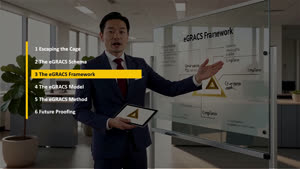
In today's explainer, we're going to boot up the systems and cover 1. Escaping the compliance cage 2. The eGRACS Schema explained 3. The Framework 4. The Model 5. The Method and finally, 6. Future-proofing your enterprise Alright, jumping right into Section 1 — Escaping the Cage Now, take a look at the massive contrast here. On one side, you've got this bloated, siloed checklist approach of the past. On the other, the sleek, dynamic architecture of the future.
Don't get me wrong, traditional control-based frameworks like ISO, ITIL, or COBIT are fantastic, but they're often applied in totally separate universes within the exact same company. And that just leads to redundant efforts and totally misaligned priorities. eGRACS, though, gives you a dynamic architecture.
It creates this one single source of truth, where risk registers, security controls, and audit tasks actually talk to each other and inform each other automatically, instead of just living as fragmented, isolated spreadsheets. It really requires a fundamental shift in how we think. Control isn't a cage, it's the structure that sets you free.
Good governance isn't about locking everything down so nobody can move. It's about making sure your enterprise can move rapidly, in the exact right direction, without breaking apart when the pressure hits. Which brings us to Section 2 — The eGRACS Schema Explained So the crucial takeaway here is that this schema is a three-part, independent structure.
We've got the framework, the model, and the method. And they all work together as a seamless, cybernetic system. The framework — that gives you your strategic structure and unified controls.
The model acts as the contextual bridge to actual global regulations. And the method is literally your operational playbook for customizing and rolling it out. Together, they are exactly how you achieve true enterprise governance, risk, audit, compliance, and security.
Let's zoom in a bit. Section 3 — The Framework, Our Strategic Pillar - 120 — just let that number sink in. That represents a massive, game-changing consolidation.
The eGRACS Framework actually fuses the best elements from roughly two dozen global standards into exactly 120 unified ICT controls. So instead of juggling thousands of overlapping requirements, which is just a headache, you get this sleek, hand-selected core that is insanely effective for medium and large enterprises. But — and this is key — it isn't just some flat list of 120 bullet points.
These controls are structured into what eGRACS calls Golden Triangles. These are 40 interdependent triads of controls. And because they're interdependent, if you update just one control in the triad, the others naturally adapt to the new context.
It forms a self-balancing, resilient micro-ecosystem, which basically prevents your whole system from breaking whenever something changes. And this architecture scales so beautifully through a four-tiered fractal hierarchy. At the very top, you have the core tier, with just three foundational controls.
Then it cascades down to the strategic tier, with nine focus area controls. Then it expands to the operational tier, with 27 actionable controls, before finally grounding itself in the tactical tier, with 81 hands-on controls. It's totally brilliant because it scales exactly like a tree, just naturally expanding its branches as your business grows.
Alright, moving across the bridge. Section 4, the Model. You know, a theoretical framework is totally useless if you can't actually map it to the real world.
That's exactly what the Model does. It translates those 120 controls into actionable, compliance-ready tools. You get practices that align directly to heavy mandates like HIPAA or Solvency II.
You get pre-designed templates for your policies, risk reports, and audit forms. And you get SOPs that give you step-by-step implementation instructions. It literally makes the framework speak the exact language of your specific industry.
But what happens when a new law drops out of nowhere? Well, that is where continuous normalization saves the day. It uses an engine called Global Evolution Mapping. So as global laws like the EU AI Act evolve, this system automatically updates all your layers in unison.
No stress, no panic. It just keeps your enterprise's governance incredibly tight and entirely future-proof without all those crazy fire drills. So how do we actually roll it out? Section 5, the Method.
The eGRACS Method isn't some rigid, one-size-fits-all template. It's a customization engine. Depending on your organization's maturity, you can deploy this in multiple directions.
Need to enforce a high-level vision? Go top-down from the core. Are you in a spot where you just need to fix broken processes in the trenches right now? Go bottom-up and iterate. Or, and this is what most large enterprises do, use a hybrid approach, which acts as a simultaneous diagnostic and design scaffold.
The real reason this works for the long haul is the dynamic feedback loop. This makes sure your governance is never just a static rulebook collecting dust. You constantly evaluate the real-world performance of your controls.
You gather feedback on operational efficiency, you refine those governance processes, and you adapt. This basically guarantees that your governance structure seamlessly bends and moulds to your unique company beat. It stays right-sized for exactly where your business is today.
Let's wrap this all up. Section 6, future-proofing. Because of its fractal nature, the eGRACS Schema gives you this absolutely incredible scalability.
It acts as a single source of truth that your board of directors can completely rely on, while at the exact same time it allows for flawless execution down on the ground. As your enterprise inevitably grows in complexity, this architecture just fluidly expands right along with you. So, I'm going to leave you with this question to chew on.
Are you going to remain trapped in that siloed compliance cage, just constantly reacting to the next audit fire drill? Or will you build the architecture that actually sets your enterprise free to innovate safely? The choice of how you govern your future is completely up to you. Thank you so much for joining me for this explainer, and I really hope it gave you a clear, exciting blueprint for your own enterprise transformation.
Subscribe to Our Video Updates
Stay informed with the latest eGRACS tutorials, insights, and strategies by subscribing to our video updates.
Looking for more?
🔍Search🏆Accreditation
eGRACS Accrediation

🤝Calling Consultants
Independent Consultants

🤽Video Explainers
What is eGRACS
🎧Vodcasts
eGRACS Framework Intro